WHOSE CITY IS IT?
PERFORMANCE, ACTIVISM, AND SPATIAL POLITICS IN NEW YORK CITY 1981-1991
The following text is from my dissertation for the completion of my Master's in the History of Art in 2023 at the Courtauld Institute of Art. Currently WIP editing down for web.
In the decade following 1981, distinct patterns of cultural production emerged following the homelessness crisis that struck New York City. If walking through the Lower East Side of Manhattan, one may have unknowingly bumped into Taiwanese born performance artist Tehching Hsieh circulating Tompkins Square Park, during his One Year Performance 1981-1991, where he was living outdoors, analogous to the homeless people who visibly filled the streets. A few years later, in 1988, one could have seen Andrew Castrucci beginning to lead Bullet Space, a squatting activist group in their three year street posters and book project, Your House Is Mine, which saw abandoned structures in New York become covered in hand printed posters created by artists and activists, implanting windows in neglected spaces to make visible the political objectives of those on the Lower East Side. After a glance at the posters erected in and around Tompkins Square Park, one may have been able to catch a glimpse of Pope. L performing Tompkins Square Crawl, where he brought himself to his hands and knees, crawling, to bring attention to the site and a police riot targeting unhoused individuals living in the park that had recently occurred. These artworks are threaded together by the Lower East Side and Tompkins Square Park as a historical site of resistance and each work is created in intimate dialogue with the political climate of New York City in the 1980s, where these artists make a visible claim and interrogation on a city that is changing before their eyes.
Familiarly known as the Mayor of Tompkins Square Park, Nathaniel “Junior” Hunt lived in the park starting in 1983 after being evicted from his rent-controlled apartment. In an interview with Bullet Space, Hunt speaks of the many versions of the park that have existed throughout history, and its current form now as a living space, out of necessity describing it as 'not permanent housing, but still a park for everybody.' Nestled between Avenue A and B and East Seventh and East Tenth Street, Tompkins Square Park has always constituted the “heart” of the Lower East Side of Manhattan.
Since its inception in 1834, the 10-acre urban oasis, lined with greenery and paths converging in restful public areas, has always offered an escape from city living. The Lower East Side in the mid to late 1800s was characterised principally by tenement housing, where the living conditions were highly unsanitary, poorly ventilated, and without basic infrastructure like heating, adequate plumbing, and safety measures. Throughout the Lower East Side’s history, Tompkins Square Park has acted as a political meeting place for working-class and immigrant communities, shaping the area’s reputation as an activist epicentre in New York. Through demonstrations, protests, and activism, Tompkins Square was cemented as a space for successful political action, becoming a cornerstone to its history for decades to follow.
New York City in the 1970s found itself in a fiscal crisis. The decade was memorialised by films like Taxi Driver, Fort Apache, The Panic in Needle Park and The Bronx, where the city, as described by American historian Kim Phillips-Fein, is shown as a “sea of filth and despair, an urban cesspool” after years of disinvestment and blight. It is widely remembered by residents as an environment plagued by crime, violence, lawlessness, disorder, graffiti, inflation, unemployment, and out-of-control budgets. It was, in other words, “an era of social breakdown, economic malaise, and political collapse.” However, as the city began to rebuild under the improved economic conditions of the early 1980s, a new crisis emerged, this time in housing. An unprecedented number of individuals found themselves on the street, displaced by policies which turned low-income housing into spaces intended primarily for the affluent, marked by a severe reduction in social service provisions.
Needing shelter from the street, public spaces like parks and transportation systems became housing for displaced individuals. Along with its physical rebuilding, however, the city sought to rebuild its image, which meant ridding unhoused individuals from public space. This triggered a tumultuous period surrounding Tompkins Square Park from 1988-1991, starting with the police riot of August 6th and 7th, 1988, where city officials unsuccessfully attempted to impose a night-time curfew on park use. Residents understood themselves as fighting back against the “yuppies and real estate magnates” that had declared war on the people of Tompkins Square Park. Battles over the park continued until June 1991, when some 300 police, “barricading all adjacent streets and surrounding the park with 8-foot high metal fences” closed the park for more than a year.
In tandem with the unrest, Tehching Hsieh’s solitary one-year stay outdoors, William Pope. L’s crawl alongside the perimeter of Tompkins Square, and the visual culture of Bullet Space’s activistism pasted in and around the park were simultaneously circulating. These artists found themselves in a new version of the Lower East Side; a creative space characterised by a politically engaged mode of artistic production.
The flourishing of the Downtown art scene in the Lower East Side was not without precedent, as the area had long been an incubator for “new and experimental culture.” Starting with the beatniks in the 1950s and the counterculture of the 1960s, poets, artists, and activists moved in and established quirky shops, poet’s cafes, avant-garde theatres and eccentric performance spaces. As opposed to the long-standing community of German, Czech, Jewish and Italian immigrants and new immigrants saw those from Poland, Ukraine, and Puerto Rico that were “fleeing squalor overseas,” these new artistic arrivals were fleeing “spiritual impoverishment in middle America in search of liberation through willingly accepted squalor.” This politically active immigrant and working-class community, mixed with the artistic Downtown alternative spirit, created a melting pot that was at once novel but also upheld the activist spirit that had long characterised the area.
The alternative-space movement of the 1970s and 1980s saw a proliferation of creative venues which attempted to “undermine the capitalist system represented by commercial galleries and major museums by showing cheap art such as artists’ books, ‘unsaleable’ works of temporary installations and even less salable performance art.” This was the context for Taiwanese-American artist Tehching Hsieh’s One Year Performance, 1981-1982 and American artist William Pope. L’s Tompkins Square Park Crawl, part of his two-week residency How Much Is That N* In The Window. Both pieces were exhibited at the art space Franklin Furnace, founded by Martha Wilson in 1976, located at 112 Franklin Street in the Tribeca area of Manhattan. The space focused on showcasing art – particularly works of performance or conceptualism – that was overlooked by the mainstream; works with an “ephemeral nature” that made their future in the art world precarious from the moment of conception.
Hsieh and Pope. L’s artistic practices are both inextricably linked with their attention to the body’s subjugation as visible other. Both artists explore the marginalised individual’s right to space in a political context — Downtown Manhattan — where space is under threat. American performance theorist Peggy Phelan sees the ephemeral and fleeting work of art’s existence as only in the “present” as once it participates in representation, it becomes “something other than performance” for “it becomes itself through disappearance.” Live performance functions purely through the visible but “disappears into memory, into the realm of visibility and the unconscious where it eludes regulation and control” with its representative trace left open for interpretation. I will use Phelan’s theories to investigate how both Hsieh’s and Pope. L’s works engage with the contradictory structures of representation and visibility within the subjugated arena of public space.
Alongside alternative art spaces, alternatives for housing were being established by squatting and homesteading movements in an attempt to provide housing which the city had failed to supply. During the fiscal crisis, on the Lower East Side, South Bronx, and Harlem, landlords, through nonpayment of taxes, deflection of repairs, and in some cases, arson, abandoned buildings as a means to drive out lower-income tenants. With these damaged buildings seized, the city proceeded to abandon them or demolish them, or sealing and warehousing them, “evicting tenants and condemning buildings for lack of the simple repairs they refused to make.” Yet, there was an unprecedented amount of unhoused people on the street and an obvious need for affordable housing as rents escalated across the city.
The squatter's movement thus began to lead the charge in taking over these abandoned buildings. One group in particular, Bullet Space, used their tools, labour, and found materials to adapt these lifeless structures into functional spaces for living and working. Bullet Space was formed in 1986 when a group of squatters moved into an abandoned building at 292 East 3rd Street. Acting as a community access centre that embodies “the images, words, and sounds of the inner city,” they were profoundly involved in the protests that took place at Tompkins Square Park. Though well studied as an organisation, little critical art historical scholarship has been given to their four-year project Your House Is Mine, 1988-1992. The project includes activist manifestos, interviews with people from in the neighbourhood, writings and a collection of thirty posters made by artists living in the Lower East Side which were wheat-pasted around the neighbourhood and throughout Manhattan. From this, Andrew Castrucci created a large, built book of screen printed material, containing the activist texts and original editions of the posters. 150 publications of Your House Is Mine were made and are now disseminated in major museums internationally. I will utilise the writings and posters from Your House Is Mine to reflect upon the housing crisis, squatting, and art’s relationship to gentrification during this period, alongside an interview I conducted with Andrew Castrucci, who provided insight into the production of Your House Is Mine and an experiential account of the Lower East Side throughout the tumultuous political period these three artistic projects engage with.
This dissertation will use as one of its theoretical lenses the work of French philosopher Henri Lefebvre and will be applying some of his writings about spatial politics to the arena of practice that these artists are engaging in. As Chris Butler highlights, Lefebvre’s book The Production of Space was “instrumental in the development of radical, materialist, and theoretically critical approaches to space.” For Lefebrve, space is more than a location, but rather a political arena, where the individuals existing within it are dictated by relations of production and property ownership. Public space in New York City became of heightened literal and metaphorical value post-fiscal crisis. Urban historian Themis Chronopoulos argues that after the fiscal crisis of 1975, neoliberalism ordered the city, with the government promoting mainstream economic development while cutting budgets and services to low-income populations, in the hopes that the free market would impose order on individuals. However, homelessness and poverty reached an all-time high, with the effects of human displacement being obviously visible in public spaces. To restore order in the city, public space was seen as something that needed to be cleansed of signs of ‘disorder,’ like crime and homelessness. Under Mayor Ed Koch, city officials had first taken aim at the growing homeless presence in the city’s parks and public transportation. This was enacted through the use of curfews and closing parks under the guise of renovations to dictate when one could access a public space to prevent the homeless from sleeping in parks overnight. This dissertation will look at the Lower East Side as a politically controlled space in which subjecthood is defined and ordered, policed, and othered.
In the coming chapters, I will provide an account of Tehching Hsieh’s One Year Performance, 1981-1982 (hereafter Outdoor Piece), Pope L’s Tompkins Square Park Crawl and Bullet Space’s multi-faceted project Your House Is Mine, seeing these works as radical responses to urban spatial politics, neoliberalist restructuring of space and attitudes towards the large and visible number of unhoused individuals in the 1980s. Chapter one begins by looking at Hsieh’s year-long expenditure in public space during Outdoor Piece and his acquired anonymity as protection allowing him to navigate public space despite his status as an illegal immigrant in America. I will use Hsieh’s performance to introduce city policies which figured homeless people as visible transgressions needed to be cleansed of in public space. Chapter two surveys Pope. L’s use of contradictory identity signifiers and encounter in Tompkins Square Crawl which make visible the societal dynamics that undergird an individual’s access to public space. These two artists use visibility and performance to reflect on the subjugated nature of an increasingly exclusionary public space in a rapidly developing capitalist urban setting. From this, Chapter three will look at how Bullet Space’s project Your House Is Mine intervened in public and private spheres through their cultural production and the act of squatting, to reclaim space that had been taken from the citizens in New York. In this environment, gentrification displaced those who once called the artistic, vibrant space of Tompkins Square Park and the Lower East Side home. These three artworks are created directly in dialogue with the area’s history of resistance, threaded together through their site and visible interventions in the spaces that are being refigured by political changes which turned the city into a predominantly pro-business urban system that no longer functioned for its all citizens but for capital gain.
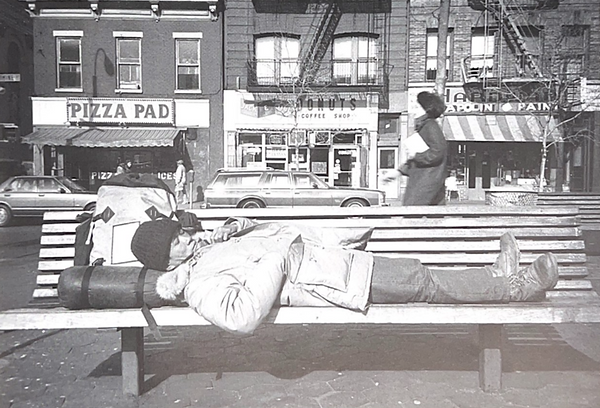
Tehching Hsieh, One Year Performance 1981-1982, 1981-1982. © Tehching Hsieh, 1982

© Ephemeral New York
